In critical care, emergency response, and surgical environments, the choice of a blood and fluid warmer is a clinical decision — not a procurement formality. When cold intravenous fluids or refrigerated blood products are infused rapidly without warming, the patient's core body temperature drops. The consequences — perioperative hypothermia, coagulopathy, cardiac arrhythmia, and delayed recovery — are well-documented and preventable. A reliable blood and fluid warmer directly addresses this risk at the point of infusion. This guide covers the primary clinical uses of a blood and fluid warmer, the safety standards that matter, how to evaluate specifications, and how VRP Medgands' Warmline® 100, Warmline® 100 Plus, and Warmflow® are designed to meet these requirements across OT, ICU, emergency, and field environments.
What is a Blood and Fluid Warmer?
A blood and fluid warmer is a specialized medical device designed to safely warm intravenous (IV) fluids, whole blood, blood products, and irrigation solutions before they are administered to a patient.
During prolonged surgical procedures, trauma care, and massive transfusions, maintaining normothermia (normal body temperature) is incredibly difficult. Even standard room-temperature IV fluids can shock a compromised systemic ecosystem. A dedicated blood and fluid warming system bridges this gap, delivering thermal stability directly into the infusion line.
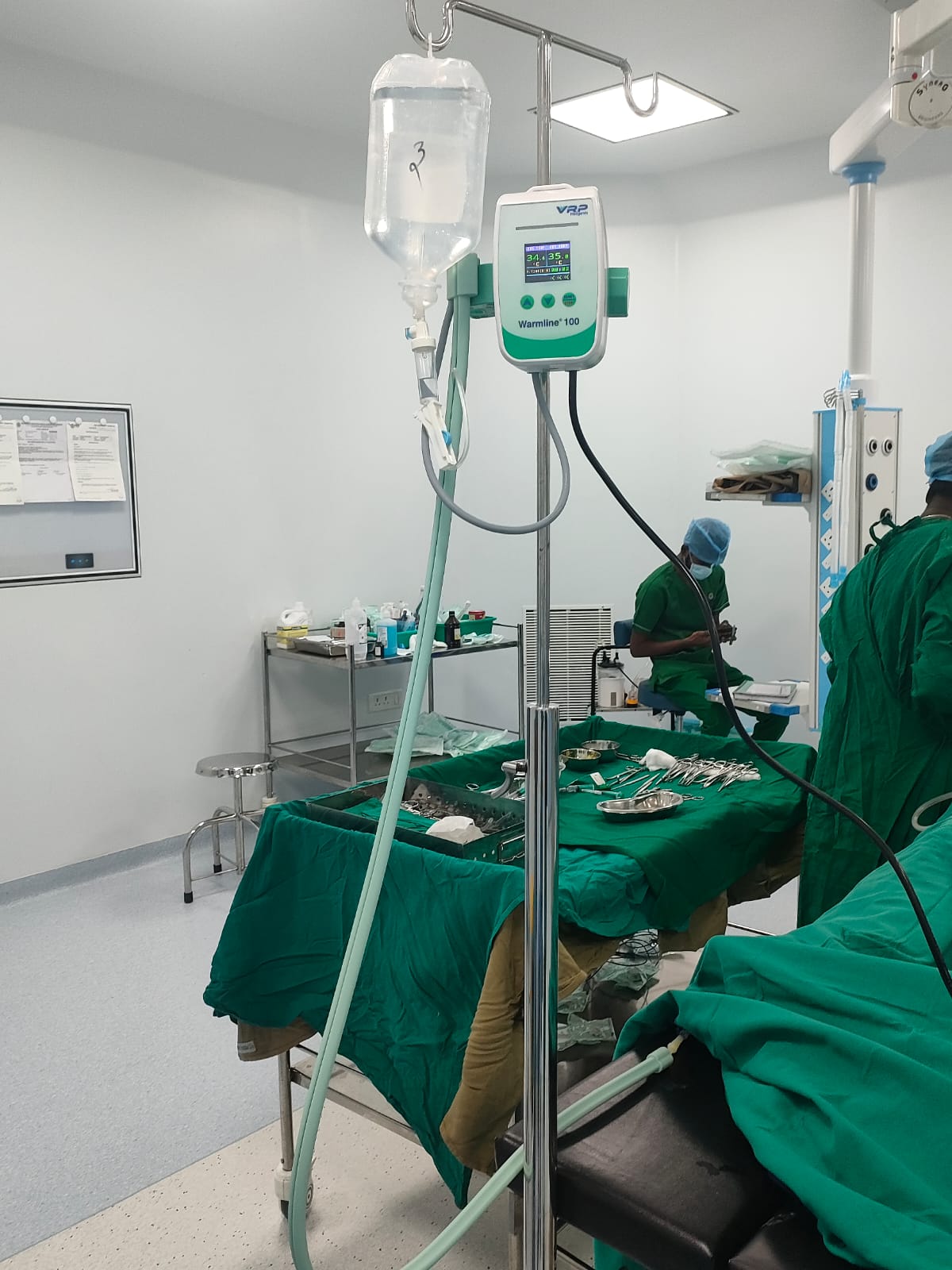
Primary Blood and Fluid Warmer Uses in Modern Healthcare
Why would you use a blood warmer in a hospital or field environment? The clinical applications span across multiple departments:
1. Preventing Perioperative Hypothermia
Perioperative hypothermia occurs when a patient's core body temperature falls below 36°C during surgery. It affects millions of surgical patients annually. Utilizing a hospital blood warmer during anesthesia keeps the patient’s core temperature stable, drastically reducing the risk of shivering and delayed thermal recovery.
2. Emergency Rooms and Trauma Centers
In trauma situations requiring massive transfusions, cold blood straight from the blood bank can induce cardiac arrhythmia or arrest. A blood and fluid warmer for emergency rooms allows rapid infusion of life-saving fluids at exact physiological temperatures.
3. Specialized Patient Demographics
- Blood and Fluid Warmer for Elderly Patients: Older adults have a compromised thermoregulatory response, making them highly susceptible to rapid cooling during simple IV fluid delivery.
- Neonatal and Pediatric Care: Infants cannot regulate their own body heat efficiently; hence, a precise medical blood warmer is mandatory during pediatric fluid administration to prevent hypothermic shock.
4. High-Volume Surgical Procedures
Blood warming solutions are heavily utilized and highly recommended for:
- Cardiac surgery
- Orthopedic surgery
- Organ transplantation
- Critical care units (ICU)
Why Cold Fluids Are Dangerous: The Technical Risk
Infusing fluids without a fluid warming system creates an invisible revenue and health leak for hospitals. Rapid administration of cold fluids lowers body temperature and significantly increases the risks of:
- Excessive Bleeding: Hypothermia impairs blood coagulation pathways.
- Cardiac Events: Cold fluid shocks the central cardiovascular system.
- Delayed Recovery & Longer ICU Stays: Prolongs patient suffering and increases hospital bed turnaround times.
IV Fluid Warmer for Hospital OT, ICU & Emergency Use
An IV fluid warmer is a dedicated medical device positioned inline on an intravenous administration set to heat fluids before they reach the patient's bloodstream. In hospital environments, the need for an IV fluid warmer varies by department — but the clinical rationale is consistent across all of them: refrigerated IV fluids and blood products administered at 4–6°C without warming can reduce core body temperature by 1–2°C per litre infused. At high infusion rates, this drop happens fast.Operating Theatre (OT)
The OT is the highest-risk environment for perioperative hypothermia. Patients are sedated, immobile, and exposed — body temperature regulation is significantly reduced. Any surgery lasting longer than 30 minutes where IV fluids or blood products are administered carries a hypothermia risk. A blood and fluid warmer mounted on the IV pole, inline with the infusion set, eliminates cold-fluid hypothermia as a variable. VRP Medgands' Warmline® 100 is designed specifically for this setting — rapid warm-up under 2 minutes, no additional consumables, and universal IV set compatibility from 3.5mm to 5mm outer diameter.
Intensive Care Unit (ICU)
ICU patients — particularly post-surgical, trauma, or ventilator-dependent patients — require continuous IV fluid administration over extended periods. In multi-bed ICUs where multiple warming devices operate simultaneously, device monitoring becomes a clinical workflow challenge. The Warmline® 100 Plus addresses this directly: its built-in Wi-Fi transmits temperature logs and device status to a Central Monitoring System (CMS) application in real time, allowing nursing staff to monitor all devices from a single dashboard without bedside supervision for each unit. It integrates with existing HIS and EMR systems for documentation and compliance.
Emergency Department
Emergency admissions — trauma, haemorrhage, sepsis, or cardiac events — frequently require rapid, high-volume fluid resuscitation. Speed of setup is non-negotiable. The Warmline® 100 is built for exactly this scenario: unpack, plug in, and it is operational — no priming, no consumable kits, no calibration. The device reaches the target temperature (37°C–42°C) in under 2 minutes. For trauma cases requiring simultaneous blood transfusion and IV fluid administration, the Warmflow® supports dual IV line warming — both lines warmed simultaneously from a single device.
Neonatal and Paediatric Wards
Neonates and paediatric patients are at disproportionate risk from hypothermia — their surface-area-to-body-mass ratio means temperature regulation is inherently vulnerable. Fluid warming at very low flow rates is essential and technically demanding: the device must maintain ±1°C accuracy even at flows as low as those required for neonatal infusions. The Warmflow® Very Long & Low tubing mode is engineered for this exact requirement — extended warming pathway, low flow rate, consistent temperature delivery throughout.
Blood and Fluid Warmer in Pre-Hospital and Field Settings
The need for blood and fluid warming does not begin at the hospital door. In ambulance transport, pre-hospital trauma response, and field medical operations, refrigerated blood products and cold IV fluids are administered under conditions where hypothermia risk is compounded by environmental exposure, patient haemorrhage, and limited monitoring capability.
VRP Medgands' Warmline® 100 is suitable for pre-hospital and ambulance use. Its compact, lightweight design mounts on a standard IV pole and requires no additional accessories or consumables beyond a standard power source. The device is operational in under 2 minutes — critical in time-sensitive field scenarios. No proprietary infusion sets are required: it is compatible with standard IV and blood transfusion sets already carried in ambulance and emergency kits.
For field medical teams managing multiple patients simultaneously — trauma response, disaster relief, or military medical units — the Warmflow® dual-line capability allows a single device to warm blood for one patient and IV fluids for another concurrently, reducing equipment requirements per patient.
Technical Blood and Fluid Warmer Specifications to Look For
When evaluating a blood and fluid warming device, senior biomedical engineers look for strict performance parameters to ensure clinical safety:
| Technical Specification | Standard Requirement | Why It Matters for Patient Safety |
|---|---|---|
| Temperature Range | 32°C to 42°C | Ensures optimal physiological warming without overheating. |
| Heating Technology | Dry Heat Technology | Eliminates recurring disposable costs and medical waste. |
| Safety Sensors | Dual Safety Monitoring | Continuous self-diagnostics prevent accidental over-temperature. |
| Mounting Capability | Quick Pole-Mount Design | Essential for fast-paced emergency and operating rooms. |
| Alarms | Audible & Visual Alarms | Alerts staff instantly to high/low temperature shifts. |
Dry Heat vs. Disposable-Based Systems: The Cost-Savings Factor
The global blood fluid warming medical device market is shifting rapidly. Historically, hospitals used warmers that required expensive, single-use disposable heating cartridges or dedicated proprietary infusion sets.
Today, advanced systems utilize Dry Heat Technology.
- Lower Operating Costs: No recurring disposable expenses per procedure.
- Faster Setup Time: Ideal for field blood warmers and rapid deployment in ambulances.
- Reduced Biomedical Waste: Supports modern eco-friendly hospital compliance standards.
Blood and Fluid Warmer Price in India (2026 Guide)
The blood and fluid warmer market features a wide price spectrum based on accuracy, integrated safety systems, and brand certifications.
An approximate breakdown of the price ranges within the Indian healthcare market is detailed below:
- Basic IV Fluid Warmers: ₹17,000 – ₹30,000
- Standard Blood & Fluid Warmers: ₹30,000 – ₹70,000
- Advanced Blood & Fluid Warmers: ₹70,000 – ₹1,20,000
- Premium International Brands: ₹1,20,000 – ₹1,80,000+
- Heating Technology — Silicone Heating Profile
- Temperature Range — 32°C – 42°C
- Warm-up Time — Under 2 minutes
- IV Tube Compatibility — 3.5mm – 5mm outer diameter
- Pole Compatibility — 8mm – 36mm
- Additional Consumables — Not required
- Safety Standard — IEC 60601, tested in NABL-accredited lab
- Best For — OT, ICU, Emergency, Ambulance, Field use
- Heating Technology — Silicone Heating Profile
- Temperature Range — 32°C – 42°C
- Warm-up Time — Under 2 minutes
- Wi-Fi Connectivity — Built-in, enabled by default
- Cloud Monitoring — Real-time data to secure cloud server
- CMS Integration — Centralized dashboard for multi-device monitoring
- HIS / EMR Integration — Supported
- Remote Access — Monitor from anywhere via mobile app (Android & iOS)
- Additional Consumables — Not required
- Best For — Multi-ICU hospitals, compliance-focused facilities, teaching hospitals
- Heating Technology — Aluminium Plate Heating
- Temperature Accuracy — ±1°C
- Flow Rate — Up to 300 ml/hr
- IV Lines — Dual lines simultaneously for a single patient
- Tubing Modes — Low / Medium / Long / Very Long & Low
- Wi-Fi — Optional (future-ready)
- Additional Consumables — Not required
- Best For — High-volume surgery, trauma, neonatal, paediatric, multi-line infusion
- IEC 60601-1-2 (4th Edition)
Ensures electromagnetic compatibility in operating rooms and ICU environments. - Dry-Heat Warming Technology
Eliminates infection risks associated with older water-bath warming systems. - Intelligent Safety Alarms
Audible and visual alerts for over-temperature (>42°C), flow interruption, or system malfunction. - NCBI / PubMed: Impact of perioperative hypothermia on patient outcomes
- The Lancet: Thermal management and infection risk in surgical patients
- NICE Guidelines (CG65): Hypothermia – prevention and management in adults undergoing surgery
The Analyst's Insight: While buying the cheapest device might save capital upfront, low-cost devices often lead to higher lifetime costs due to mandatory disposable cartridges, frequent downtime, and lack of authorized local calibration support.
VRP Medgands Blood and Fluid Warmers — Find the Right Model for Your Clinical Setting
VRP Medgands manufactures three blood and fluid warmer models — each designed for specific clinical demands. All three are CDSCO-registered, tested to IEC 60601 medical electrical safety standards in NABL-accredited laboratories, and require no proprietary consumables. The right choice depends on your infusion volume, monitoring requirements, and clinical environment.
Warmline® 100 — Compact Blood and Fluid Warmer
The Warmline® 100 is VRP Medgands' flagship single-line blood and fluid warmer for operating theatres, ICUs, emergency departments, and ambulance/field use. Built on silicone heating profile technology, it warms IV fluids and blood products from refrigerated temperature to 37°C–42°C in under 2 minutes. It mounts on any IV pole (8mm to 36mm diameter), works with standard IV and blood transfusion sets (3.5mm–5mm outer diameter), and requires no additional consumables, calibration, or accessories.
Warmline® 100 Plus — Wi-Fi Enabled Blood and Fluid Warmer
The Warmline® 100 Plus carries all the clinical capabilities of the Warmline® 100, and adds built-in Wi-Fi connectivity for real-time data transmission to a secure cloud server. This makes it the right choice for multi-ICU hospitals, teaching hospitals, and facilities with compliance and documentation requirements. Device temperature logs, usage hours, device ID, and serial number are continuously transmitted to the Central Monitoring System (CMS) application — accessible from anywhere in the hospital or remotely. Multiple Warmline® 100 Plus units across different ICUs and OTs can be monitored from a single CMS dashboard, and the data integrates with HIS and EMR systems for audit and documentation.
Warmflow® — Dual-Line Advanced Blood and Fluid Warmer
Warmflow® is VRP Medgands' most advanced blood and fluid warmer, built on aluminium plate heating technology and engineered for high-demand clinical scenarios where a single IV line is not sufficient. It simultaneously warms two IV infusion lines for a single patient — making it the device of choice for trauma resuscitation, major surgery, and any protocol requiring concurrent blood transfusion and IV fluid administration. Warmflow® is also the world's first blood and fluid warmer to offer four dedicated tubing modes in this technology class, allowing clinicians to select the correct warming pathway for the procedure type.
Product Comparison Table
| Feature | Warmline® 100 | Warmline® 100 Plus | Warmflow® |
|---|---|---|---|
| Heating Technology | Silicone Profile | Silicone Profile | Aluminium Plate |
| Temperature Range | 32°C – 42°C | 32°C – 42°C | 32°C – 42°C |
| Temperature Accuracy | ±1°C | ±1°C | ±1°C |
| Warm-up Time | Under 2 min | Under 2 min | Flow-based |
| IV Lines Supported | Single | Single | Dual simultaneous |
| Flow Rate | Standard | Standard | Up to 300 ml/hr |
| Wi-Fi / Cloud | No | Default on | Optional |
| CMS / EMR Integration | No | Yes | Optional |
| Tubing Modes | Standard | Standard | 4 modes |
| Consumables Required | None | None | None |
| Safety Standard | IEC 60601 / NABL | IEC 60601 / NABL | IEC 60601 / NABL |
| Best For | OT, ICU, Emergency, Field | Multi-ICU, Compliance | Trauma, Neonatal, High-volume |
What Clinicians Say About VRP Medgands' Blood and Fluid Warmers
The Warmline® 100 is in daily clinical use at leading hospitals across India — including Apollo Hospitals, KG Hospital, Ganga Hospital, Medway Hospital, and CMC. Here is what anaesthesiologists and clinical leads say.
"The device meets my clinical needs to a great extent and proves to be safe for clinical use. It performs consistently well under different conditions and compares favourably to other similar products in the market."
"Its ease of use, consistent temperature control, and durable build have been highly appreciated by our staff. We value the reliability it brings to patient care."
"The device meets our clinical needs effectively and is safe for use in a paediatric setting. I would rate it 9 out of 10."
"The Warmline® 100 maintains stable performance even during demanding procedures. It is quick to set up, straightforward for staff to operate, and dependable in maintaining the desired temperature."
Trusted by Leading Hospitals Across India








Safety Standards and Trust
Healthcare facilities should prioritize blood and fluid warmers that align with recognized safety and performance standards:
Clinical References
Medical Disclaimer
This content is intended for healthcare professionals, hospital administrators, and medical equipment procurement teams. It is provided for informational purposes only and does not constitute medical advice. Clinical decisions should always follow institutional protocols, manufacturer instructions, and applicable medical guidelines.


 No 54/11, 1st Floor, 4th
Street, Rukmani Nagar,Poonamallee, Chennai -600056.
No 54/11, 1st Floor, 4th
Street, Rukmani Nagar,Poonamallee, Chennai -600056.
